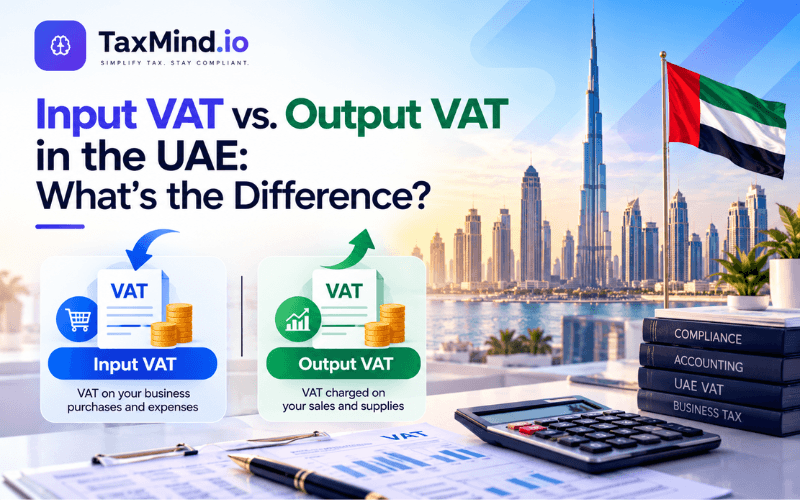
Input VAT vs. Output VAT in the UAE: Key Differences
- Author: TaxmindIO Team
- Published: 9 Oct 2026
Introduction: The Two Numbers Behind Every UAE VAT Return
Every VAT-registered business in the UAE files a return that comes down to two figures: how much VAT you charged your customers, and how much VAT you paid on your own purchases. The difference between those two numbers is what you either pay to the Federal Tax Authority (FTA) or reclaim from them.
These two figures have formal names. The VAT you charge customers is called output VAT. The VAT you pay on purchases is called input VAT. Understanding how each one works — what qualifies, what does not, and what the rules are for recovery — is the foundation of VAT compliance in the UAE.
This guide explains both in plain language: how to calculate your VAT position, which input VAT you can and cannot recover, what the 2026 amendments to the UAE VAT Law change for businesses, and how to stay on top of both numbers every quarter without errors.
Key Takeaways
- Input VAT is the VAT incurred on business purchases, expenses, and imports.
- Output VAT is the VAT charged on taxable goods and services supplied by a business.
- The UAE standard VAT rate is 5%, although certain supplies are zero-rated or exempt.
- Eligible VAT-registered businesses can generally recover input VAT related to their taxable business activities, subject to applicable conditions.
- If output VAT exceeds recoverable input VAT, the business generally pays the difference to the FTA.
- If recoverable input VAT exceeds output VAT, the business may be entitled to a refund or may be able to carry the excess forward, subject to the applicable rules.
- Accurate records, valid tax invoices, and timely VAT return filing are essential for compliance.
Read: UAE VAT Registration: Know all about
What is Output VAT?
Output VAT is the VAT you collect on behalf of the Federal Tax Authority when you make a taxable supply.
In the UAE, the standard VAT rate is 5%. When you sell goods or services that are subject to VAT at the standard rate, you add 5% to the sale price, charge that amount to your customer, and hold it until your return is due. The customer pays it to you, but it belongs to the government — you are collecting it on behalf of the FTA.
Output VAT applies to:
- Sales of standard-rated goods and services within the UAE
- Imports of goods into the UAE (handled through customs clearance at the point of entry)
- Reverse charge supplies — where you, as the UAE business, account for VAT on services purchased from a non-resident supplier who is not VAT-registered in the UAE (such as cloud software subscriptions billed from overseas)
- Goods and services provided to employees that are taxable as deemed supplies
Output VAT does not apply to:
- Zero-rated supplies (international transport, export of goods, certain financial services, residential property first supply) — these are taxable at 0%, meaning you charge no VAT but can still recover the input VAT on your related costs
- Exempt supplies (bare land, residential property subsequent supply, local passenger transport, bare financial services) — no VAT is charged and input VAT on related costs generally cannot be recovered
Simple example:
You are a UAE-based technology company. In a quarter, you invoice clients AED 400,000 for implementation services. All services are standard-rated.
Output VAT = AED 400,000 × 5% = AED 20,000
This AED 20,000 is what you have collected and must account for in your VAT return.
What Is Input VAT?
Input VAT is the VAT you pay when you purchase goods or services for your business. Provided the purchase relates to your taxable business activities and you hold a valid tax invoice, you can generally deduct this amount from the output VAT you owe — effectively recovering it.
Input VAT recovery is one of the defining features of the VAT system. It prevents tax from cascading through supply chains. Businesses act as intermediaries: they collect VAT from customers and pass it to the government, but only on the value they add — not on the value they paid for to begin with.
Input VAT can be recovered when:
- You hold a valid tax invoice from a VAT-registered supplier showing the supplier's TRN, the VAT amount, and the required invoice details
- The purchase is used for your taxable business activities (standard-rated or zero-rated supplies)
- The VAT has been or will be paid
- The recovery is claimed within five years of the end of the relevant tax period (a new requirement introduced from 1 January 2026)
Simple example (continuing from above):
In the same quarter, your business incurred the following purchases:
- Software licenses: AED 80,000 + AED 4,000 VAT
- Office supplies: AED 20,000 + AED 1,000 VAT
- Server hardware: AED 60,000 + AED 3,000 VAT
Total Input VAT = AED 4,000 + AED 1,000 + AED 3,000 = AED 8,000
Also read: UAE VAT Return Filing: A Complete Guide for 2026
Input VAT vs. Output VAT: Key Differences
Input VAT and output VAT are two sides of the same VAT system, but they serve different purposes in business accounting.
| Comparison | Input VAT | Output VAT |
|---|---|---|
| Meaning | VAT incurred on purchases and expenses | VAT charged on taxable sales and supplies |
| Transaction type | Purchases, expenses, and imports | Sales and other taxable supplies |
| Who charges or pays it? | The supplier generally charges it to the purchasing business | The selling business generally charges it to the customer |
| Business accounting | Recorded as input tax, with recoverability assessed separately | Recorded as output tax payable under applicable rules |
| Recovery or payment | May be recoverable if the legal requirements are met | Generally accounted for and paid to the FTA, after eligible deductions |
| Example | VAT on eligible office equipment | VAT on taxable consulting services |
| VAT return treatment | Reported in the input tax section | Reported in the output tax section |
The main difference is that input VAT relates to what a business buys, while output VAT relates to what it sells or supplies.
How to Calculate VAT Payable in the UAE
For a VAT-registered business, the basic calculation is:
Net VAT payable = Output VAT − Recoverable Input VAT
This calculation determines the business's net VAT position for the relevant tax period. It assumes that the input VAT included in the calculation is recoverable and that any required adjustments have been considered.
Example 1: Output VAT Is Higher Than Input VAT
Suppose a business records the following amounts during a tax period:
| Description | Amount |
|---|---|
| Output VAT on taxable supplies | AED 15,000 |
| Recoverable input VAT | AED 9,000 |
| Net VAT payable | AED 6,000 |
Calculation:
AED 15,000 − AED 9,000 = AED 6,000
The business generally needs to pay AED 6,000 to the FTA for the period, subject to any other applicable adjustments.
Example 2: Input VAT Is Higher Than Output VAT
Now suppose a business has incurred substantial setup costs or purchased equipment during a period when its sales were relatively low.
| Description | Amount |
|---|---|
| Output VAT | AED 4,000 |
| Recoverable input VAT | AED 7,000 |
| Excess recoverable input VAT | AED 3,000 |
Calculation:
AED 4,000 − AED 7,000 = −AED 3,000
The business has an excess recoverable input VAT position of AED 3,000. Depending on the applicable rules and the business's circumstances, it may be able to request a refund or carry the excess forward against future VAT liabilities.
An excess input VAT balance does not automatically guarantee an immediate cash refund. The business must meet the relevant conditions and follow the FTA's procedures.
When Can a UAE Business Recover Input VAT?
Input VAT recovery is an important consideration for VAT-registered businesses. It can reduce the effective cost of eligible business purchases and prevent VAT from becoming an unnecessary expense.
However, recovery is subject to specific requirements under UAE VAT legislation.
1. The Purchase Must Meet the Recovery Requirements
The expense must qualify for input tax recovery under the applicable VAT rules. VAT incurred on purchases related to taxable business activities may generally be recoverable, subject to restrictions and other conditions.
Expenses related to exempt activities or non-business purposes may not qualify for full recovery.
2. The Business Must Have Appropriate Supporting Documents
Businesses should retain valid tax invoices or other documentation accepted under the applicable rules to support the amount of input VAT claimed.
Records should clearly show the supplier, transaction, VAT amount, and other required information.
3. The VAT Must Be Paid or Intended to Be Paid
Under the FTA's VAT return guidance, recovery generally requires the relevant tax to have been paid, or to be intended to be paid, in whole or in part. The recoverable amount may be limited where only part of the amount has been paid or is intended to be paid.
Businesses should review the specific conditions applicable to their transactions.
4. The Expense Must Not Fall Under a Recovery Restriction
Certain expenses may be subject to input tax recovery restrictions. Businesses should not assume that VAT charged on every invoice is recoverable simply because the invoice relates to an expense.
The treatment may depend on the expense category, business purpose, use of the goods or services, and the legislation in force.
5. The Claim Must Be Reported Correctly
Eligible input VAT should be included in the appropriate VAT return for the relevant period, following the FTA's reporting requirements.
Businesses should reconcile their purchase records, tax invoices, accounting entries, and VAT return figures before filing.
Practical tip: Establish a process for reviewing input VAT before claiming it. This is particularly useful for businesses with mixed taxable and exempt activities, significant imports, or high volumes of supplier invoices.
What Happens When Input VAT Is Not Recoverable?
If input VAT does not qualify for recovery, the business generally cannot deduct it from its output VAT liability.
For example, suppose a company incurs AED 1,000 in VAT on an expense but determines that the amount is not recoverable under the applicable rules. It should not automatically include that AED 1,000 as a recoverable input tax deduction.
Instead, the VAT may need to be treated as part of the expense or asset cost, depending on the circumstances and the applicable accounting treatment.
Incorrectly claiming input VAT can lead to inaccurate returns and potential compliance issues.
Businesses should review expenses carefully and obtain professional advice when the VAT treatment is uncertain.
Input VAT on Taxable, Zero-Rated, and Exempt Supplies
Understanding the difference between taxable, zero-rated, and exempt supplies is essential when assessing input VAT recovery.
Standard-Rated Supplies
Standard-rated supplies are generally subject to 5% VAT in the UAE.
For example, a business selling taxable products for AED 10,000 would generally charge AED 500 in VAT, assuming the standard rate applies.
Input VAT related to taxable business activities may generally be recoverable if the relevant conditions are satisfied.
Zero-Rated Supplies
Zero-rated supplies are taxable supplies subject to a 0% VAT rate.
Qualifying exports and certain specified supplies may fall into this category, subject to the relevant conditions. A zero-rated supply is not the same as an exempt supply.
Businesses making zero-rated supplies may generally recover eligible input VAT associated with those supplies, provided the applicable requirements are met.
Exempt Supplies
Exempt supplies are not charged VAT in the same way as taxable supplies. Certain financial services, residential property transactions, and other specified supplies may be exempt depending on the applicable rules and circumstances.
Input VAT related to exempt supplies is generally not recoverable, subject to the relevant legislation.
Where purchases relate to both taxable and exempt activities, input VAT may need to be apportioned under the applicable rules.
This distinction matters because a business's VAT recovery position depends not only on how much VAT it pays but also on the activities to which its expenses relate.
How Input VAT and Output VAT Are Reported on a UAE VAT Return
VAT-registered businesses must report their relevant transactions through the FTA's VAT return process.
The return generally includes information about taxable supplies, output VAT, purchases and expenses, recoverable input VAT, and the resulting net VAT position. Additional reporting may be required for matters such as imports, reverse-charge transactions, zero-rated supplies, exempt supplies, and adjustments.
A practical reporting process includes the following steps:
Collect sales records: Review sales invoices, credit notes, and other documents relating to taxable supplies.
Calculate output VAT: Determine the output VAT due on relevant transactions and account for required adjustments.
Review purchase records: Collect supplier invoices and supporting documents for expenses and imports.
Check input VAT recovery: Confirm that the claimed amounts meet the applicable recovery conditions.
Reconcile the figures: Compare accounting records, invoice totals, and VAT return figures.
Submit the return and settle the liability: File the return and pay any amount due within the applicable deadline.
The FTA states that VAT returns and related payments are generally due within 28 days from the end of the relevant tax period. Businesses should verify their assigned tax period and filing deadline rather than assume every business follows the same reporting schedule.
Accurate reconciliation helps businesses reduce errors, identify missing invoices, and maintain reliable VAT records.
Common Mistakes Businesses Make With Input VAT and Output VAT
Even businesses with established accounting systems can make VAT reporting mistakes. Some of the most common issues include the following.
Claiming Input VAT Without Checking Eligibility
A supplier invoice showing VAT does not automatically establish that the purchasing business can recover the amount.
How to avoid it: Review the business purpose, supply type, supporting documents, and applicable recovery restrictions before including the amount in the return.
Treating Zero-Rated and Exempt Supplies as the Same
Both may result in no VAT being charged to the customer, but their treatment is different. In particular, input VAT recovery can differ significantly.
How to avoid it: Classify transactions correctly and review the relevant UAE VAT guidance when a supply's status is uncertain.
Forgetting VAT on Certain Transactions
Businesses may overlook credit notes, imports, reverse-charge transactions, or adjustments that need to be reflected in their returns.
How to avoid it: Use a consistent period-end checklist that covers sales, purchases, imports, adjustments, and other applicable VAT reporting categories.
Using Incorrect Invoice Information
Missing or incorrect invoice details can make it difficult to substantiate a recovery claim or reconcile transactions.
How to avoid it: Review tax invoices when they are received, request corrections where necessary, and retain supporting records.
Missing the VAT Return Deadline
Late filing or payment can create compliance problems and may result in penalties under the applicable rules.
How to avoid it: Maintain a tax calendar, assign clear responsibilities, and prepare reconciliations before the filing deadline.
Assuming an Excess Input VAT Balance Will Automatically Be Refunded
An excess of recoverable input VAT over output VAT may create a refundable position, but a refund is subject to the relevant requirements and procedures.
How to avoid it: Review the FTA's refund process and maintain the documentation needed to support the claim.
Check: How AI Classifies Invoices for UAE VAT
Best Practices for Managing Input VAT and Output VAT
Businesses can improve VAT compliance by adopting a structured accounting process.
- Maintain separate records: Track output VAT and input VAT separately to simplify reconciliation.
- Use accounting software: Configure tax codes carefully and ensure the software reflects the correct treatment of different supplies and expenses.
- Review invoices regularly: Check sales and purchase documents throughout the tax period instead of waiting until the filing deadline.
- Reconcile VAT accounts: Compare the general ledger, tax invoices, and VAT return calculations before submission.
- Monitor changes in tax rules: Review relevant FTA publications and amendments that may affect registration, reporting, or input tax recovery.
- Keep supporting documents: Store invoices, credit notes, import records, and other evidence in an organized and accessible format.
- Seek professional advice when needed: Obtain assistance for complex transactions, mixed-use expenses, international supplies, and uncertain VAT classifications.
These practices help businesses improve reporting accuracy and make their VAT position easier to understand.
The 2026 VAT Law Amendments: What Changed for Input and Output VAT
Federal Decree-Law No. 16 of 2025 came into effect on 1 January 2026, amending the UAE VAT Law in several ways that directly affect how businesses manage input and output VAT.
1. Five-year deadline on input VAT recovery
Before 2026, there was no fixed time limit on claiming excess input VAT credits — balances could carry forward indefinitely. From 1 January 2026, excess input VAT must be claimed within five years from the end of the relevant tax period. After this deadline, the right to recover that input VAT is permanently lost.
Critical action required: Businesses that have accumulated input VAT credit balances from earlier periods — particularly those from 2018, 2019, and 2020 — must claim these by 31 December 2026 under the transitional relief provisions. This is not optional. Unused credits that predate 2021 will expire at the end of the year if not claimed.
2. Denial of input tax recovery linked to tax evasion
The 2026 amendments give the FTA the explicit power to deny input VAT recovery where a transaction is linked to tax evasion — even if the buyer did not directly participate — provided the buyer knew or should have known that the transaction was part of an evasion scheme. This places a new due diligence obligation on VAT-registered businesses to verify the legitimacy of their suppliers.
3. Self-invoicing for reverse charge removed
Previously, businesses accounting for VAT under the reverse charge mechanism were required to issue a self-invoice to document the transaction. From 2026, this requirement is removed. Businesses must instead retain the supplier's invoice and relevant import documentation as their evidence for the reverse charge transaction.
4. New penalty framework for late payments
Cabinet Decision No. 129 of 2025, effective 14 April 2026, revised the penalty structure for VAT non-compliance:
- Late payment: 14% per annum on the outstanding amount
- Tax shortfall: 15% fixed penalty plus 1% per month
- Voluntary disclosure before FTA audit: 1% per month only (the 15% fixed penalty is waived)
How to Record and Report Both Correctly
On your tax invoices (output VAT): Every tax invoice you issue must show: your TRN, a sequential invoice number, the invoice date, the supply date (if different), the customer's details, a description of the goods or services, the unit price, the VAT rate, the VAT amount in AED, and the total amount including VAT. For invoices below AED 10,000, a simplified tax invoice is permitted. Invoices must be issued within 14 days of the date of supply.
On your purchase invoices (input VAT): To recover input VAT, you must hold a valid tax invoice that shows all required fields — including the supplier's TRN. A receipt, a proforma invoice, or a commercial invoice without a TRN does not qualify for input tax recovery. Verify your suppliers' TRN on the FTA's public register before recording input VAT.
In your VAT return: The VAT201 return on EmaraTax has dedicated fields for:
Standard-rated supplies (output VAT)
Zero-rated supplies
Exempt supplies
Recoverable input tax
Non-recoverable (blocked) input tax
Net VAT payable or refundable
Returns are typically filed quarterly and are due, together with payment, by the 28th of the month following the end of the tax period. If net VAT is payable, payment must be made by the same deadline. If excess input tax exists, you can either carry it forward or apply for a refund.
How TaxMind.io Handles Input and Output VAT Automatically
TaxMind.io is built specifically for the UAE VAT environment. Its AI-powered VAT Classification engine processes every transaction — sales, purchases, imports, and reverse charge supplies — and assigns the correct VAT treatment automatically.
For output VAT, TaxMind.io generates FTA-compliant tax invoices with all required fields, tracks the output VAT on every customer transaction, and populates the correct return fields automatically. For input VAT, it separates recoverable from non-recoverable costs at the transaction level, flags invoices that lack a valid TRN, tracks cumulative input tax credit balances with their five-year expiry dates, and alerts your team before any credit balance approaches the recovery deadline.
The VAT201 return is prepared from live transaction data — not from manual spreadsheet reconciliation — with a built-in accuracy check before submission. The FTA e-invoicing mandate taking effect in 2027 for AED 50M+ businesses is already supported through TaxMind.io's e-invoicing infrastructure, giving businesses that need to be ready before the deadline a clear path.
Over 500 UAE companies currently use TaxMind.io to manage their VAT compliance across all seven Emirates, with 96% AI accuracy on VAT classification and more than 1 million invoices processed.
Frequently Asked Questions
1. What is the difference between input VAT and output VAT in the UAE?
Input VAT is the VAT a business incurs on purchases, expenses, and imports. Output VAT is the VAT it charges on taxable sales and supplies. A VAT-registered business generally calculates its net VAT position by subtracting recoverable input VAT from output VAT.
2. What is the VAT rate in the UAE?
The UAE's standard VAT rate is 5%. However, certain supplies are zero-rated or exempt, so businesses must determine the correct treatment for each transaction.
3. Can a business recover all the input VAT it pays?
No. Input VAT recovery depends on the applicable UAE VAT rules, the purpose and use of the purchase, supporting documentation, and any relevant restrictions. Some amounts may be fully recoverable, partly recoverable, or non-recoverable.
4. What happens if output VAT is higher than input VAT?
If output VAT exceeds recoverable input VAT, the business generally pays the difference to the FTA for the relevant tax period, after considering applicable adjustments.
5. What happens if input VAT is higher than output VAT?
The business may have an excess recoverable input VAT position. Subject to the applicable requirements, it may be able to request a refund or carry the excess forward against a future VAT liability.
6. Is input VAT the same as VAT paid to suppliers?
Input VAT generally refers to VAT incurred on purchases and imports. However, not every amount of VAT paid to a supplier is automatically recoverable. The business must assess whether the amount qualifies under UAE VAT rules.
7. Is output VAT the same as revenue?
No. Revenue is the value earned from selling goods or providing services, while output VAT is the tax charged on taxable supplies. VAT collected from customers should be accounted for separately from business revenue in accordance with the applicable accounting treatment.
8. Can a business recover input VAT on zero-rated supplies?
Input VAT related to zero-rated taxable supplies may generally be recoverable if the relevant recovery requirements are met. Zero-rated supplies should not be confused with exempt supplies.
9. When must a UAE business file its VAT return?
The FTA states that VAT returns and related payments are generally due within 28 days from the end of the relevant tax period. The business should confirm its assigned tax period and applicable deadline.
10. How can a business avoid input VAT and output VAT errors?
Businesses should maintain accurate invoices, use appropriate tax codes, check input tax recovery eligibility, reconcile their accounts, and review their VAT returns before submission. Professional guidance can help with complex transactions or uncertain tax treatments.
Conclusion
Understanding input VAT and output VAT is essential for managing VAT compliance in the UAE.
Input VAT relates to VAT incurred on business purchases and imports, while output VAT relates to VAT charged on taxable supplies. For a VAT-registered business, the difference between output VAT and recoverable input VAT generally determines its net VAT position for the relevant tax period.
However, accurate VAT reporting involves more than subtracting one figure from another. Businesses must classify supplies correctly, verify input VAT recovery eligibility, maintain supporting documentation, and meet the FTA's filing and payment requirements.
By establishing reliable accounting procedures and reviewing official VAT guidance regularly, businesses can improve compliance, reduce avoidable errors, and manage their VAT obligations with greater confidence.
For transactions involving complex recovery restrictions, exempt activities, imports, or other special circumstances, businesses should consult a qualified UAE tax professional or the Federal Tax Authority's official guidance.
Disclaimer: This article provides general information about UAE VAT and is not a substitute for professional tax advice. VAT treatment depends on the facts of each transaction and the legislation and guidance applicable at the time.