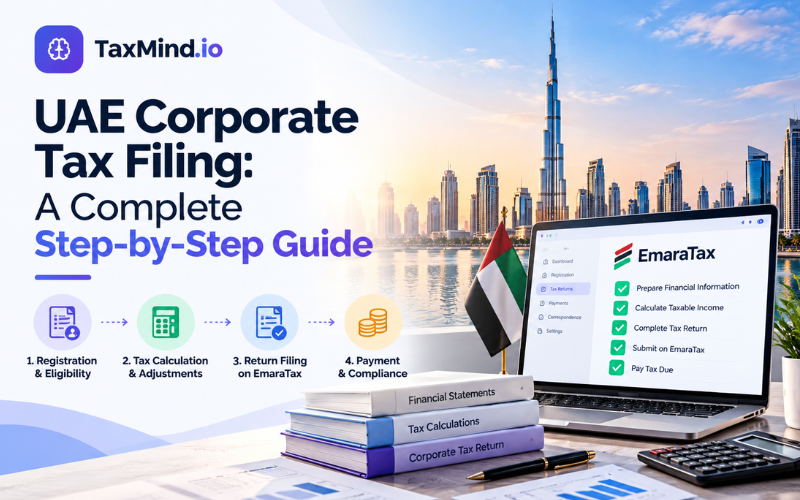
UAE Corporate Tax Filing: A Complete Step-by-Step Guide
- Author: TaxmindIO Team
- Published: 21 Oct 2026
The introduction of Corporate Tax in the United Arab Emirates (UAE) has changed how businesses manage their accounting, financial reporting, and tax compliance responsibilities. Companies must understand whether they are subject to Corporate Tax, maintain accurate financial records, calculate their taxable income correctly, and submit their tax returns within the applicable deadlines.
For many business owners, the filing process can seem complicated, especially when dealing with deductible expenses, tax adjustments, Free Zone rules, related-party transactions, and the Federal Tax Authority's online filing system.
The good news is that understanding the process in advance can make Corporate Tax filing more manageable.
UAE Corporate Tax filing involves determining your tax obligations, preparing financial information, calculating taxable income, completing the Corporate Tax Return, submitting it through the EmaraTax platform, and paying any tax due within the prescribed deadline.
This guide explains each step in practical terms to help UAE businesses prepare for Corporate Tax filing, avoid common mistakes, and maintain better tax compliance.
Important note: This article provides general information, not individualized tax or legal advice. UAE Corporate Tax legislation, implementing decisions, and FTA guidance may change. Always verify the requirements applicable to your business using official FTA and UAE Ministry of Finance resources.
Key Takeaways
- Corporate Tax applies to taxable businesses: UAE companies, certain nonresident entities, and natural persons conducting qualifying business activities may fall within the scope of Corporate Tax.
- Registration and filing are separate obligations: Businesses should determine whether they must register for Corporate Tax and submit the required return or declaration.
- The standard filing deadline is nine months: Corporate Tax Returns and payments are generally due within nine months after the end of the relevant tax period.
- Taxable income is not necessarily the same as accounting profit: Tax adjustments may be required for exempt income, nondeductible expenses, and other items under UAE tax rules.
- The standard Corporate Tax rates are 0% and 9% at specified taxable-income thresholds: A 0% rate applies to taxable income up to AED 375,000, and a 9% rate generally applies to taxable income exceeding AED 375,000, subject to applicable rules.
- Free Zone businesses must assess their own tax position: Operating in a Free Zone does not automatically exempt a business from Corporate Tax.
- Accurate records are essential: Financial statements, transaction records, supporting documents, and relevant tax calculations help businesses prepare accurate returns and demonstrate compliance.
Read: UAE VAT Registration - Eligibility, Process & Common Mistakes
What is UAE Corporate Tax?
UAE Corporate Tax is a federal tax imposed on the taxable income of businesses and other persons covered by the Corporate Tax Law.
The legal framework was introduced under Federal Decree-Law No. 47 of 2022 on the Taxation of Corporations and Businesses, as amended. It applies to financial years beginning on or after June 1, 2023.
The Federal Tax Authority administers the tax system, including registration, return filing, collection, and enforcement.
Unlike a tax calculated directly on total sales, Corporate Tax is generally calculated using taxable income determined under the applicable tax rules. Accounting profit is the starting point, but certain adjustments may be necessary before arriving at the final taxable amount.
UAE Corporate Tax Rates
The standard UAE Corporate Tax rates are:
| Taxable Income | Standard Corporate Tax Rate |
|---|---|
| Up to AED 375,000 | 0% |
| Above AED 375,000 | 9% |
| MNE groups above EUR 750M global revenue | 15% (DMTT) |
These thresholds apply to taxable income, not simply business revenue. Businesses must calculate taxable income under the applicable rules before determining the amount of tax payable.
Certain businesses may qualify for different treatments or special regimes. For example, Qualifying Free Zone Persons may be eligible for a 0% rate on qualifying income if they satisfy the applicable conditions. Different rules also apply to certain large multinational enterprise groups subject to the UAE's Domestic Minimum Top-up Tax regime.
Consequently, businesses should not assume that every company is taxed in precisely the same way.
Also read: Input VAT vs. Output VAT in the UAE - Key Differences
Who Needs to File a UAE Corporate Tax Return?
Determining whether your business must file a Corporate Tax Return is the first step in the process.
Corporate Tax obligations depend on the legal structure of the business, its activities, residency status, exemptions, and applicable tax rules.
1. UAE Companies and Other Juridical Persons
UAE-incorporated companies and other juridical persons generally fall within the Corporate Tax regime unless a specific exemption or other applicable treatment applies.
Examples may include:
- Limited liability companies.
- Private and public joint-stock companies.
- Other UAE-incorporated legal entities conducting business.
The exact obligations depend on the entity's legal status and circumstances.
2. Free Zone Companies
Businesses established in UAE Free Zones are also within the Corporate Tax framework.
A Free Zone company may qualify for a 0% Corporate Tax rate on qualifying income if it satisfies the requirements for Qualifying Free Zone Person status.
However, this is not an automatic exemption. The company must assess the applicable conditions, including relevant income classifications and compliance requirements.
Free Zone businesses should therefore review their tax position carefully before preparing and filing a return.
3. Foreign Companies With a UAE Permanent Establishment
A foreign company may have Corporate Tax obligations if it has a taxable presence in the UAE, such as a Permanent Establishment under the applicable rules.
The tax treatment depends on the facts, relevant legislation, and any applicable tax treaty provisions.
Foreign businesses operating in the UAE should determine whether their activities create registration, filing, or payment obligations.
4. Individuals Conducting Business Activities
Natural persons conducting business or business activities in the UAE may be subject to Corporate Tax when they meet the applicable requirements.
For natural persons, the relevant registration threshold is based on business revenue, not personal salary or all personal income.
The FTA states that a natural person conducting business activities is required to register when annual business revenue exceeds AED 1 million within a calendar year, subject to the applicable rules and exclusions. Salary, personal investment income, and real estate investment income are excluded from the relevant revenue calculation under the specified conditions.
5. Exempt Persons
Certain entities may be exempt from Corporate Tax if they meet specific legal conditions.
Examples include certain government entities, qualifying public benefit entities, and qualifying investment funds.
However, exemption from Corporate Tax does not always mean exemption from registration, reporting, or recordkeeping requirements. Some exempt persons may still need to register or submit an annual declaration.
Businesses should confirm their status rather than assuming that an exemption removes every compliance obligation.
Documents Required for UAE Corporate Tax Filing
Preparing the necessary records before starting the filing process can make the return easier to complete and review.
The documents required will vary depending on the company's size, activities, accounting arrangements, and tax position.
The following checklist provides a useful starting point.
1. Corporate and Registration Documents
Keep the relevant business information available, including:
- Trade license and incorporation documents.
- Corporate Tax Registration Number.
- Legal name and registered business address.
- Details of authorized representatives.
- Relevant registration and ownership information.
Confirm that the information used for filing agrees with the records held by the FTA.
2. Financial Statements
Prepare the financial statements for the relevant tax period.
Depending on the business, these may include:
- Income statement or statement of profit and loss.
- Balance sheet.
- Cash flow statement, where applicable.
- Notes and supporting financial schedules.
- Relevant audit reports, if required.
Financial statements provide the starting point for determining taxable income.
3. Accounting Records
Maintain supporting accounting records such as:
- Sales invoices.
- Purchase invoices.
- Bank statements.
- Expense receipts.
- Payroll records.
- Fixed asset registers.
- Loan and financing records.
- Journal entries and general ledger reports.
These documents help support the figures reported in the tax return.
4. Tax Calculation Schedules
Prepare schedules showing how accounting profit or loss has been adjusted to calculate taxable income.
Depending on the circumstances, these may cover:
- Exempt income.
- Nondeductible expenditure.
- Depreciation and relevant asset adjustments.
- Tax losses carried forward.
- Tax loss relief claimed.
- Tax credits, where applicable.
- Related-party transactions.
- Other tax adjustments required by law.
5. Related-Party and Connected-Person Information
If the business conducts transactions with related parties or connected persons, review the applicable disclosure and transfer pricing requirements.
Depending on the business and transaction, relevant information may include:
- The identity of related parties.
- The nature of the relationship.
- Transaction amounts.
- Supporting agreements.
- Evidence supporting the pricing of transactions.
- Transfer pricing documentation, where required.
Not every business has the same disclosure or documentation obligations. Requirements depend on the relevant rules, thresholds, and circumstances.
6. Free Zone and Other Special-Regime Records
Businesses claiming special tax treatment should maintain records supporting their eligibility.
For a company seeking Qualifying Free Zone Person treatment, relevant information may include income classifications, financial records, and evidence demonstrating compliance with applicable conditions.
Important: A document checklist is a preparation aid, not a definitive list of mandatory attachments for every return. Consult the latest FTA Corporate Tax Return guidance to identify the information required for your specific filing.
The FTA publishes official return guidance and supporting materials through its Corporate Tax guides and references.
UAE Corporate Tax Filing: A Step-by-Step Guide
Once you understand your obligations and have gathered the required financial information, you can begin preparing the return.
Step 1: Confirm Your Corporate Tax Registration
Before filing, verify that the business has completed the required Corporate Tax registration.
Registered businesses should confirm that their Corporate Tax Registration Number and relevant taxpayer information are accurate.
If your business has not registered, first determine whether registration is required and identify the applicable registration deadline.
The FTA provides Corporate Tax registration services through the EmaraTax platform. Its official registration service page explains the application process and supporting documentation.
What to check:
- Is the business required to register?
- Has the registration application been completed?
- Is the Corporate Tax Registration Number available?
- Are the company's legal and contact details correct?
- Does the business have the necessary account access?
Remember that registration and filing are separate obligations. Completing one does not automatically satisfy the other.
Step 2: Identify the Correct Tax Period
Determine the tax period covered by the return.
For many companies, the tax period follows the financial year used for accounting purposes. However, the applicable period should be confirmed based on the company's circumstances and relevant rules.
Identify:
- The beginning of the tax period.
- The end of the tax period.
- The applicable accounting period.
- The return filing deadline.
Using the wrong period can lead to incorrect reporting or missed deadlines.
Example: If a company's relevant tax period runs from January 1 to December 31, the return should cover that period rather than an arbitrary twelve-month period selected during preparation.
Step 3: Close the Accounts and Prepare Financial Statements
Before calculating Corporate Tax, ensure that the accounts for the relevant period have been properly closed.
Review the company's income, expenses, assets, liabilities, and accounting adjustments.
Check for:
- Missing sales invoices.
- Unrecorded expenses.
- Duplicate transactions.
- Incorrectly classified payments.
- Outstanding receivables and payables.
- Incomplete bank reconciliations.
- Incorrect fixed asset or depreciation records.
Resolve material discrepancies before using the accounts for tax calculations.
Accurate financial information is essential because accounting profit or loss generally forms the starting point for determining taxable income.
Step 4: Calculate Accounting Profit or Loss
Identify the accounting profit or loss reported in the financial statements for the relevant period.
For example, suppose a business reports the following figures:
| Item | Amount |
|---|---|
| Revenue | AED 1,500,000 |
| Operating and other expenses | AED 1,200,000 |
| Accounting profit before tax | AED 300,000 |
The accounting profit before tax is AED 300,000.
However, this does not automatically mean that AED 300,000 is the final taxable income.
The business must determine whether tax adjustments are required under UAE Corporate Tax rules.
Step 5: Adjust Accounting Profit to Determine Taxable Income
Accounting profit and taxable income can differ because certain income and expenses receive specific treatment under the Corporate Tax Law.
Relevant adjustments depend on the nature of the transactions and the applicable rules.
For example:
- Certain income may qualify for exemption.
- Some expenses may be wholly or partially nondeductible.
- Specific tax loss relief provisions may apply.
- Other adjustments may be required for transactions involving related parties or connected persons.
The objective is to calculate taxable income in accordance with the law, not simply copy the profit figure from the income statement.
Illustrative Tax Calculation
Assume a company has accounting profit before tax of AED 300,000 and determines that it has AED 20,000 in expenses that are nondeductible for Corporate Tax purposes.
For illustration, assume there are no other tax adjustments.
| Calculation | Amount |
|---|---|
| Accounting profit before tax | AED 300,000 |
| Add: Nondeductible expenses | AED 20,000 |
| Illustrative taxable income | AED 320,000 |
Under the standard Corporate Tax rate structure, taxable income of AED 320,000 falls below the AED 375,000 threshold and would generally be subject to a 0% rate.
This example is simplified. Actual tax treatment depends on the business's circumstances, eligibility for relevant provisions, and the applicable law.
Step 6: Review Deductions, Exempt Income, and Tax Relief
Review the tax treatment of significant income and expense categories before finalizing the calculation.
Important areas may include:
- Deductible business expenses: Determine whether the expense meets the applicable requirements for deductibility.
- Exempt income: Identify income that qualifies for exemption under the Corporate Tax Law.
- Tax losses: Determine whether eligible losses are available for carryforward or relief and whether the relevant conditions are satisfied.
- Small Business Relief: Assess whether the business qualifies for the relief under the rules applicable to the relevant tax period.
- Free Zone treatment: If applicable, determine whether the company satisfies the conditions for Qualifying Free Zone Person status and which income qualifies for the relevant treatment.
These provisions are not automatic. Each must be assessed under the applicable legislation and guidance.
For example, businesses should not assume that every expense appearing in their accounting records is deductible for Corporate Tax purposes.
Likewise, businesses should not assume that a Free Zone license automatically qualifies all income for a 0% Corporate Tax rate.
Step 7: Calculate the Corporate Tax Payable
Once taxable income has been determined, calculate the Corporate Tax liability using the applicable rates and rules.
Under the standard rate structure:
- Taxable income up to AED 375,000 is generally subject to a 0% rate.
- Taxable income exceeding AED 375,000 is generally subject to a 9% rate, subject to the applicable rules and special regimes.
For example, assume a business has taxable income of AED 500,000 and is subject to the standard rate structure.
The illustrative calculation would be:
| Calculation | Amount |
|---|---|
| Taxable income | AED 500,000 |
| Portion subject to 0% rate | AED 375,000 |
| Portion subject to 9% rate | AED 125,000 |
| Illustrative Corporate Tax | AED 11,250 |
The calculation is:
AED 125,000 × 9% = AED 11,250.
This example assumes that the business is subject to the standard rate structure and that no other adjustments, reliefs, credits, or special rules change the result.
The applicable tax position should always be verified before filing.
Step 8: Log In to the EmaraTax Platform
The Federal Tax Authority uses EmaraTax to provide digital tax services, including Corporate Tax registration and return filing.
Visit the official FTA website and access the EmaraTax services through the available official links.
Before starting, ensure that:
- You can access the correct taxpayer account.
- The relevant Corporate Tax registration details are available.
- You have the financial figures and supporting calculations ready.
- The person submitting the return is authorized to do so.
Keep login credentials secure and restrict access to authorized personnel.
Step 9: Complete the Corporate Tax Return
Follow the instructions displayed in the Corporate Tax Return service.
The exact fields and schedules may depend on the taxpayer's circumstances and the version of the filing system available.
You may need to provide information relating to:
- The taxpayer's identity and registration details.
- The relevant tax period.
- Financial information and accounting income.
- Adjustments used to determine taxable income.
- Tax losses and relevant relief claims.
- Tax credits, where applicable.
- Related-party and connected-person transactions.
- The resulting Corporate Tax liability.
Enter the information using the figures supported by the company's accounts and tax calculations.
Do not rely on estimates where accurate information is available. If a figure requires clarification, resolve the issue before submission whenever possible.
For detailed field-by-field guidance, consult the FTA's Corporate Tax Return taxpayer user manual.
Step 10: Review the Return Before Submission
Treat the final review as an essential control, not a formality.
Before submitting the return, check the following:
- The taxpayer's legal name and registration details are correct.
- The correct tax period has been selected.
- Financial figures agree with the relevant accounting records.
- Tax adjustments are supported by appropriate calculations.
- Relevant relief claims satisfy the applicable conditions.
- Tax losses and credits are reported correctly, where applicable.
- Required disclosures have been completed.
- Related-party information has been reviewed where relevant.
- The calculated tax liability agrees with the supporting tax computation.
Where possible, have a qualified accountant or tax professional review the return, particularly when the business has complex transactions or special tax treatments.
Step 11: Submit the Return and Retain Confirmation
Once the information has been reviewed, submit the Corporate Tax Return through the official platform.
Follow the instructions displayed by the system and retain the submission confirmation and any relevant reference details.
After submission, check the account for any messages, notifications, or follow-up requirements.
Maintain a copy of the filed return and supporting tax computation as part of the company's compliance records.
Step 12: Pay Any Corporate Tax Due
If Corporate Tax is payable, arrange payment within the applicable deadline.
The filing and payment processes are related, but the FTA has clarified that the return does not necessarily have to be submitted and paid at the same moment. Both obligations must nevertheless be completed within their respective applicable deadlines.
When arranging payment:
- Confirm the amount payable.
- Follow the official payment instructions.
- Allow sufficient time for processing.
- Retain proof of payment.
- Check that the payment has been recorded appropriately.
Do not assume that initiating a bank transfer on the deadline guarantees that the payment will be received on time.
UAE Corporate Tax Penalties: What You Need to Know
Under Cabinet Decision No. 129 of 2025, effective April 14, 2026, the UAE corporate tax penalty structure has been updated. Understanding these penalties is essential for every business — both for planning purposes and for assessing the cost-benefit of voluntary disclosure if an error is discovered after filing.
| Violation | Penalty |
|---|---|
| Failure to register | AED 10,000 per entity |
| Late filing of return | AED 500/month for months 1–12; AED 1,000/month thereafter |
| Late payment of tax | 14% per annum on unpaid tax, calculated daily, no cap |
| Incorrect return (no tax difference) | AED 500 |
| Voluntary disclosure (filed proactively) | 1% per month on any tax difference |
| Error discovered in FTA audit | 15% fixed penalty + 1% per month on the tax difference |
The cost of waiting vs. disclosing:
The penalty structure is explicitly designed to make voluntary disclosure significantly cheaper than being caught in an audit. If a business discovers an error that results in AED 100,000 of additional tax six months after the filing deadline:
- Voluntary disclosure (self-reported): Tax of AED 100,000 + understatement penalty of AED 6,000 (1% × 6 months) = AED 106,000 total
- Discovered in FTA audit (after 6 months): Tax of AED 100,000 + fixed penalty of AED 15,000 + understatement penalty of AED 6,000 = AED 121,000 total
The practical implication is clear: if you discover an error or omission after filing, file a voluntary disclosure as soon as possible rather than waiting to see whether the FTA identifies it.
Common UAE Corporate Tax Filing Mistakes to Avoid
Businesses can reduce compliance risks by understanding the mistakes that commonly arise during tax preparation.
1. Missing the Filing Deadline
One of the most important responsibilities is filing within the prescribed period.
Businesses should establish an internal tax calendar, assign responsibility for preparation, and begin reviewing their accounts well before the deadline.
2. Confusing Revenue With Taxable Income
Revenue represents income generated from business activities, while taxable income is determined under the applicable tax rules.
Corporate Tax is not calculated simply by applying the standard rate to total sales.
Businesses must establish their taxable income using the relevant accounting figures and tax adjustments.
3. Assuming All Accounting Expenses Are Deductible
Not every expense recorded in the accounts necessarily qualifies for a deduction.
Businesses should review significant expense categories and confirm their treatment under the Corporate Tax Law.
Maintain supporting invoices, contracts, payment records, and explanations for material adjustments.
4. Assuming a Free Zone Company Is Automatically Tax-Exempt
Free Zone businesses must assess the conditions applicable to their tax status.
The relevant treatment depends on the company's eligibility, income classification, and compliance with the rules governing Qualifying Free Zone Persons.
Incorrect assumptions can result in an inaccurate tax calculation.
5. Ignoring Related-Party Transactions
Transactions involving related parties and connected persons may create disclosure, pricing, and documentation requirements.
Businesses should identify relevant transactions early and review the applicable transfer pricing rules.
6. Maintaining Incomplete Financial Records
Missing invoices, unreconciled accounts, and incomplete transaction records make it more difficult to prepare an accurate return.
Establish a consistent bookkeeping process and retain the documents needed to support reported amounts.
7. Treating Registration as the End of Compliance
Registering for Corporate Tax does not eliminate the need to submit required returns and pay any tax due.
Businesses should maintain an annual compliance calendar that covers registration, filing, payment, recordkeeping, and any additional obligations relevant to their circumstances.
8. Relying on Outdated Information
Corporate Tax rules, administrative decisions, and FTA guidance can change.
Use official government sources when confirming deadlines, eligibility requirements, filing instructions, and applicable tax treatments.
The UAE Ministry of Finance specifically advises taxpayers to rely on official Ministry and FTA publications for Corporate Tax information.

UAE Corporate Tax Filing Checklist
Use this checklist to organize your filing process.
| Task | What to Confirm |
|---|---|
| Corporate Tax registration | Confirm registration status and the Corporate Tax Registration Number |
| Tax period | Verify the correct beginning and ending dates |
| Financial statements | Finalize the accounts for the relevant period |
| Accounting records | Reconcile transactions and resolve discrepancies |
| Tax adjustments | Review exempt income, nondeductible expenses, and other adjustments |
| Tax relief | Confirm eligibility for any relevant relief or special treatment |
| Related-party transactions | Review applicable disclosure and transfer pricing requirements |
| Tax calculation | Calculate taxable income and the resulting liability |
| Return preparation | Complete the required information and schedules |
| Final review | Verify the figures, disclosures, and supporting records |
| Submission | File through the official EmaraTax platform |
| Payment | Pay any tax due within the applicable deadline |
| Record retention | Retain the filed return, calculations, and supporting documents |
This checklist is a general preparation tool. Businesses should adapt it to their specific legal structure, tax position, and applicable requirements.
Frequently Asked Questions
1. How do I file a UAE Corporate Tax Return?
First, confirm that your business has completed any required Corporate Tax registration. Prepare the financial statements and supporting records, calculate taxable income, and complete the Corporate Tax Return through the official EmaraTax platform. Review the information before submitting the return, retain the submission confirmation, and pay any tax due by the applicable deadline.
2. What is the deadline for UAE Corporate Tax filing?
The standard deadline is generally nine months after the end of the relevant tax period. For example, a company whose tax period ended on December 31, 2025, generally had until September 30, 2026, to file its return and pay the tax due. Always confirm the deadline applicable to your business.
3. What is the Corporate Tax rate in the UAE?
Under the standard rate structure, taxable income up to AED 375,000 is generally subject to a 0% rate, while taxable income above AED 375,000 is generally subject to a 9% rate. Certain businesses and income may be subject to special rules, so businesses should confirm their applicable tax treatment.
4. Do Free Zone companies need to file Corporate Tax Returns?
Free Zone companies are within the UAE Corporate Tax framework. A company that qualifies for Qualifying Free Zone Person treatment may be eligible for a 0% rate on qualifying income, subject to the applicable conditions. Free Zone status alone does not automatically remove filing obligations or guarantee a 0% rate.
5. Is Corporate Tax registration the same as filing a tax return?
No. Registration establishes the taxpayer's Corporate Tax registration with the FTA. Filing involves submitting the required return for the relevant tax period. Businesses should confirm and satisfy both obligations where applicable.
6. Do businesses need to file a return if they have no taxable income?
A business's filing obligations do not automatically disappear because it has no taxable income or no tax payable. Taxable persons are generally required to file a Corporate Tax Return for each relevant tax period, subject to the applicable legislation and any specific exceptions.
7. Can a small business qualify for tax relief?
Some businesses may qualify for Small Business Relief if they satisfy the relevant conditions for the applicable tax period. Eligibility should be checked against the current rules, including applicable revenue thresholds and the periods for which the relief is available. Businesses should not assume that low revenue automatically means no filing obligation.
8. What documents should I prepare before filing?
Commonly needed records include the company's registration details, financial statements, accounting records, supporting invoices, bank statements, tax calculation schedules, and information about relevant related-party transactions. Additional information may be needed depending on the business's activities and tax position.
9. Can I file my UAE Corporate Tax Return myself?
Businesses can submit their returns through the FTA's official EmaraTax platform. However, whether self-filing is appropriate depends on the complexity of the business and the person's ability to prepare an accurate return. Businesses with complex transactions, Free Zone tax considerations, or transfer pricing requirements may benefit from professional assistance.
10. What should I do if I miss the Corporate Tax filing deadline?
Review the situation promptly, check the applicable FTA requirements, and submit the outstanding return and payment as appropriate. Late filing or payment may result in administrative penalties. Consider obtaining professional advice if the circumstances are complex.
Conclusion: Make UAE Corporate Tax Filing Part of Your Business Process
UAE Corporate Tax filing becomes more manageable when businesses approach it as a structured compliance process rather than a last-minute administrative task.
The key steps are straightforward: confirm your obligations, verify your tax period, maintain accurate financial records, calculate taxable income correctly, complete the return through EmaraTax, and meet the applicable filing and payment deadlines.
Businesses should also pay close attention to special tax treatments, Free Zone eligibility, related-party transactions, and the supporting documents needed to justify their calculations.
A consistent bookkeeping process, a clear compliance calendar, and a thorough review before submission can help reduce errors and make annual filing more predictable.
For businesses that need additional support, working with a qualified UAE tax professional can help clarify complex transactions, review tax calculations, and identify applicable compliance requirements.
Looking for help with UAE Corporate Tax compliance? TaxMind.io keeps registration details, financial records, tax calculations, and filing deadlines in one place so UAE businesses can prepare Corporate Tax returns with fewer last-minute surprises.
Start a free trial with TaxMind.io.
Disclaimer: This article is intended for general informational purposes only and does not constitute tax, legal, accounting, or financial advice. Tax treatment depends on the specific facts and applicable UAE legislation. Confirm current requirements with the Federal Tax Authority or a qualified tax professional before making filing decisions.